What China’s Falling Emissions Tell Us About the Future of Home Battery Storage
19 February 2026
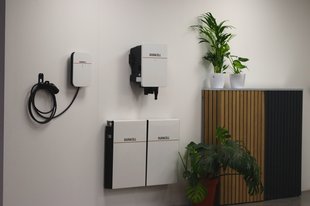
Battery storage has helped China's emissions fall, playing an important role in their decarbonisation efforts
For years, conversations about global emissions have been dominated by warnings, targets and distant ambitions. New analysis shows that China’s CO₂ emissions have now been flat or falling for 21 consecutive months, marking one of the most sustained periods of stabilisation seen in the world’s largest emitter.
The shift began in March 2024 and has continued through 2025, with emissions dropping by 1% in the final quarter of last year and likely declining overall across the year as a whole. Even small changes at this scale signal important shifts in energy systems, investment decisions and consumer adoption.
Increasingly, that shift reflects how wind and solar have become viable options despite their intermittency, and the technologies that make them usable in practice, particularly energy storage, which enables clean power to be captured, moved and relied upon at scale.
Central to this development has been the continued scaling of clean energy generation. Solar output in China has increased by 43% year-on-year and wind by 14%, while nuclear also grew.
While wind turbines and solar panels dominate headlines, a less visible technology is quietly transforming the system: energy storage. China’s expansion of storage capacity makes this impact especially clear.
The Technology Behind China’s Renewable Revolution
China added a record 75GW of energy storage capacity in 2025, exceeding the 55GW increase in peak electricity demand. That milestone matters because it marks the first time storage growth has outpaced the rise in peak loads, meaning flexibility is scaling alongside generation. In practical terms, this enables grids to rely less on fossil-fuel backup capacity and more on stored renewable energy when demand spikes.
This is critical because renewable generation does not always align with consumption patterns. Solar and wind capacity is expanding so quickly that actual output has lagged potential output in some cases, partly due to grid congestion forcing sites offline. Large-scale batteries provide the mechanism to capture that unused generation and store it for when it is needed most, representing an alternative to building new coal or gas plants for reliability.
A Signal of Global Adoption
The momentum behind renewable generation and energy storage is now reaching households worldwide. As governments invest in flexibility and utilities build capacity to capture and distribute clean power more efficiently, the technologies involved develop and become more accessible. The UK government has also committed millions of pounds through its Warm Homes Plan to support the uptake of solar, battery storage and other renewable technologies.
Battery storage, once viewed primarily as grid support infrastructure, is already moving into everyday households as a practical tool for lowering energy bills, reducing reliance on peak fossil-fuel generation and maximising the value of locally generated power.
In the UK, small-scale renewable adoption is accelerating at pace. The first half of 2025 saw a record 170,000 certified installations, driven largely by solar, battery storage and heat pumps. Battery installations alone grew by 130% year-on-year, highlighting that generation and storage go hand in hand.
Behind these numbers is a deeper behavioural shift. Households are becoming active participants in energy management, cost control and sustainability outcomes.
The Direction of Travel
China’s emissions stabilisation does not represent the endpoint of decarbonisation, nor does it eliminate the challenges ahead. CO2 emissions still remain short of official targets, and continued progress will depend on government backing and infrastructure changes.
For homeowners, the advancement in utility-scale battery storage signals a structural transition that is bringing resilience, flexibility and cost control closer to home. As battery technology continues remain a popular option for homeowners, residential storage is set to become a vital part of how energy is produced, managed and valued at household level.
What is happening at grid scale today is likely to define household expectations tomorrow, where control, flexibility, and energy independence become the new standard.